Related Posts Plugin for WordPress, Blogger...

Friday, May 25, 2012

Wall Street Survivor Gamifies Financial Education With Help From Bunchball

Anthony Ha is a writer at TechCrunch, where he covers media, advertising, and startups. Previously, he was a staff technology writer at Adweek, worked as a senior editor at the tech blog VentureBeat, and was also a reporter at the Hollister Free Lance, where he won awards from the California Newspaper Publishers Association for breaking news coverage and writing.... ? Learn More

wall street survivor logo

If you’re someone who thinks gamification is just a fad, you may want to look away now.

To be clear, Bunchball isn’t just jumping on the latest buzzword. The company was founded to deliver gamification tools all the way back in 2005 — founder and Chief Product Officer Rajat Paharia has told me that he probably came to the market too early, and has had to keep the company alive while the industry caught up. Now it’s focused largely on enterprise customers who want to use game mechanics to turn employees into better workers.

There are, however, other applications. For example: Bunchball just announced that it’s partnering with financial literacy site Wall Street Survivor. The site already offers a virtual stock market simulator, but apparently that wasn’t game enough, so it has been redesigned using Bunchball’s Nitro platform.

On the new version of Wall Street Survivor (viewable on the beta site), there are now “missions” where users learn about stock market concepts. They receive badges for completing those missions and making trades. They can also receive rewards if they have some of the best returns among the virtual portfolios in the Wall Street Survivor database.

The change is being touted as a way for the site to appeal specifically to millennial, who may be intimidated by investing and the financial world, but will enjoy the gamified approach.


Bunchball is the leading provider of online gamification solutions, used to drive high value participation, engagement, loyalty and revenue for some of the world’s leading brands and media. Customers including Warner Bros, Comcast, Victoria’s Secret PINK, USA Network, LiveOps, and Hasbro use Bunchball’s Nitro gamification platform to create compelling, meaningful and enjoyable experiences for consumers, employees, and partners. Based in Silicon Valley and founded in February 2005, Bunchball’s investors include Granite Ventures and Adobe Systems Incorporated. For more information,...

Learn more

View the original article here

VisibleGains Launches Postwire At Disrupt, Aims To Be The Flipboard For Client Communication

Matt is currently working as a writer for TechCrunch. Matt Burns is a family man first and attempts to be a writer second. Born and raised in the heart of the automotive world, only cars eclipse his love of gadgets. He previously wrote for Engadget and EngadgetHD before moving into the party house that is TechCrunch. He learned the retail... ? Learn More

postwire_darkgray

Email is broken. Social networks are not for private file distribution. Collaborative file sharing sites are missing pizzazz and key functions for the enterprise. This is the thought process behind Postwire by VisibleGains.

The company explained to TechCrunch, “We want to do for client communication what Flipboard did for blog reading.” By using a private sharing workspace, Postwire allows for both client collaboration and asset management in a visually smart way. They take shared videos, images and documents, arrange them on a grid layout similar to Pinterest, giving users within the shared group a compelling receptacle for these files. In short Postwire aims to be a landing page for shared files.

WP_SLIDESHOW_IMAGES = {load: 'http://s1.wp.com/wp-content/mu-plugins/slideshow/slideshow-loader.gif?m=1289605033g',prev: 'http://s1.wp.com/wp-content/mu-plugins/slideshow/prev.png?m=1269491733g',next: 'http://s0.wp.com/wp-content/mu-plugins/slideshow/next.png?m=1269491733g',stop: 'http://s0.wp.com/wp-content/mu-plugins/slideshow/stop.png?m=1269491733g',play: 'http://s2.wp.com/wp-content/mu-plugins/slideshow/play.png?m=1269491733g'};WP_SLIDESHOW_LABELS = {next: 'Next',prev: 'Previous',stop: 'Toggle Playback'};WP_SLIDESHOW_BLOG_INFO = {blogId: '24588526',subDomain: 'tctechcrunch2011',userId: '0'};This slideshow requires JavaScript.

Take internal designers: With Postwire they are able to upload media to a private page shared with just their client. The two can both upload and view media to their personal Postwire account, selectively sharing specific media for quick collaborative sharing. There is even a sidebar that shows usage stats of the media.

The visual interface makes browsing and selecting media a bit more Luddite-friendly than traditional file sharing sites. The dead simple workflow might be Postwire’s most compelling feature.

Postwire is a site for the masses. Files are displayed as media rather than, you know, computer files. Embeddable content like videos and pictures can be viewed directly on the site in a popup. After uploading media, emails can be sent indicating to users that a file was just uploaded intended for collaboration. I was told that an iPhone app is a few months out that will even allow for mobile uploads of pics and videos.

VisableGains launched Postwire’s private beta in April and currently has “several hundred active users.” Prior to launching at Disrupt NYC today, VisableGains has raised $2.5M through two rounds of funding from AVG Ventures including a $1.5M Seed round in September 2010.

q: What’s the price?

a: The price point will be free with a $20 plan over that which gives you 10 pages. There is other a long term plan that includes new designs.

q: This could have been done 10 years ago with HTML. What have you guys seen in the market to suggest now is the time to launch?

a: Especially over the 3-4 years there has been a visual explosion. Pages are becoming able to let users digest pages visual. People expect it. No one like getting an email with a bunch of links. There’s a possibility and an expectation.

q: A big part of your early traction will come from small and medium business – -they are traditionally very hard to target — how are you going to get them on board?

a: We think partnerships one way to start cracking. When you get shared with a Postwire page, you have to sign up for freedom account.

q: What type of files will they be sharing? Why not Pinterest or Dropbox?

a: First, with Pinterest, it’s all photos. Dropbox is al files. Frankly even a Crunchbase page can be put in as a file.

q: How do you protect from new potentially spohiscated sites?

a: By keeping it simple. These people are people who do not want to switch. You’re going to think a lot if you’re going to switch if you’re interacting with your clients with the current system.


View the original article here

Ron Conway Makes It Clear That SV Angel Is David Lee’s Fund (And It Might Be Raising Another $400M)

Alexia Tsotsis is the co-editor of TechCrunch. She attended the University of Southern California in Los Angeles, CA, majoring in Writing and Art, and moved to New York City shortly after graduation to work in the Media industry. After four years of living in New York and attending courses at New York University, she returned to Los Angeles in... ? Learn More

arr_con

Silicon Valley is full of unsung heroes: Mike Krieger, Arash Ferdowsi, interns, the TechCrunch sales team, Heather Harde and the countless engineers that keep the products we love from failing to be the products we love. One of these unsung heroes is SV Angel’s David Lee, who has served as a mentor and sounding board for almost every smart person in the Valley as far as I can tell.

But as of today Lee is a little more “sung”; In a discussion with Michael Arrington on stage at TC Disrupt New York, investor Ron Conway made it even more clear that SV Angel is actually managing partner David Lee’s fund.

The fact that Lee, who used to work at StumbleUpon and Google before co-founding SV Angel, runs the fund is perhaps the Valley’s best-kept not-secret. While Conway actually is listed as investor and not partner on the firm’s Crunchbase profile, it doesn’t stop press and others from constantly writing stuff like, “Ron Conway’s SV Angel fund,” paying scant or no attention to the man actually behind the curtain.

“This is David’s fund,” Conway said to Arrington in response to questioning about financing rumors. “But I have a huge vested interest.” Conway is still the largest investor in SVAngel, which also loops in Arrington himself as a Limited Partner, Kevin Carter, Robert Pollak and Conway’s middle son Topher Conway. “I get to come in and help entrepreneurs, I get to do what I enjoy,” Conway went on.

Interestingly enough, LP Arrington pressed Lee and Conway to comment on the “rumors” that the fund might be raising $400 million, “We are exploring all options …” Lee responded, saying that they are indeed looking for investment but refusing to give more detail.

When asked what startups were particularly interesting to SV Angel, the dynamic duo listed Pinterest (of course), Airbnb, Stripe, Square and Boku. When asked the same question of VC firms, Lee and Conway singled out Andreessen Horowitz, Sequoia, Greylock, Accel and General Catalyst as top choices.

In terms of where he saw the fund’s investment trajectory headed, Lee said that he read somewhere on TechCrunch that the way people are shopping is drastically changing (I’m going to hope he was talking about this post) and that he is most excited about companies like Warby Parker and Pinterest that are transforming the way people consume content, create relationships, and well buy stuff.

“The sharing economy,”"the open graph distributed economy,” and the “P2P sharing” model all got shout out as ecommerce movements that could soon see an influx of (new?) SV Angel cash. SV Angel’s last raise of $20 million happened a year ago last April and, with a rapidly expanding portfolio, it wouldn’t be a surprise if the “rumors” Arrington alluded onstage to are indeed true.


David Lee is the Managing Member at SV Angel, where Ron Conway is a Special Partner. SV Angel focuses its investments on early-stage consumer media companies. He focuses on investments within the consumer Internet, mobile, video and other IT industries. Prior to SV Angel, he was at Google, where he led new business development efforts in video, media and content/data partnerships. After Google, he led all business development-related efforts for StumbleUpon. Recently he was a partner at Baseline Ventures...

Learn more

View the original article here

Ron Conway Will “Never” Run For Mayor Of San Francisco

Anthony Ha is a writer at TechCrunch, where he covers media, advertising, and startups. Previously, he was a staff technology writer at Adweek, worked as a senior editor at the tech blog VentureBeat, and was also a reporter at the Hollister Free Lance, where he won awards from the California Newspaper Publishers Association for breaking news coverage and writing.... ? Learn More

ron conway

In case you were wondering: Ron Conway says he will not be running for mayor of San Francisco.

Apparently that was on Mike Arrington’s mind when he interviewed Conway and SV Angel partner David Lee on-stage at Disrupt today. He said he heard from more than one source that Conway is considering a run “somewhere down the line,” and asked flat-out if that’s true.

“That’s a rumor I can assure you is false,” Conway replied. “There’s an old saying: ‘Never say never.’ I actually believe in that saying, but I will never run for mayor of San Francisco.” Had he explored it at all? “Not for a nanosecond.”

The idea isn’t quite as out-of-left-field as it sounds. Conway has been visibly involved in civic issues recently — apparently he met with Senator Chuck Schumer recently to discuss SOPA/PIPA and immigration issues, and along with current Mayor Ed Lee and former TechCrunch CEO Heather Harde, he recently helped launch a program called sfCITI aimed at helping the tech industry and the city work together. (In fact, Conway’s relationship with Mayor Lee seemed close enough to prompt a largely critical Bay Citizen article printed in The New York Times.) When grilled about how much of his time he’s “throwing away on government work” (Arrington’s words), Conway estimated that it was 20 percent.

On the mayoral question, Conway’s response might seem pretty definitive, but Arrington wasn’t satisfied. He asked if Conway might be lying. (Conway: “I would never lie to you about this.”) Later, he asked again Conway was running.

“Last time I checked 10 minutes ago, I was not running for mayor,” Conway said.


Companies: Haute Secure, Topsy, SV Angel, 140 Proof, Start Fund, Jaxtr, Asana, Associated Content, MarketShare Partners, DonorsChoose.org, Angel Investors LP

Ronald Conway has been an active angel investor for over 15 years. He was the Founder and Managing Partner of the Angel Investors LP funds (1998-2005) whose investments included: Google, Ask Jeeves, Paypal, Good Technology, Opsware, and Brightmail. Ron was previously with National Semiconductor Corporation in marketing positions from 1973-1979, and Altos Computer Systems as a co-founder, President and CEO from 1979-1990. He eventually took Altos public in 1982 and served as CEO of Personal Training Systems (PTS)...

Learn more

View the original article here

Apptegic Uses Big Data Analysis To Help Companies Retain And Upsell Their Customers

Ryan has spent more than five years covering business, technology, and telecom-related subjects for a variety of publications based in New York and San Francisco. Ryan currently works as a writer for TechCrunch. ? Learn More

apptegic

For SaaS companies, whose customers are usually signed up on recurring monthly billing cycles, the art of retaining customers is just as important as winning them over in the first place. In fact, it’s probably more important, since customers aren’t tied in to long-term deals. It’s also a lot cheaper to retain a customer than to acquire a new one. So they need to better understand them and work harder to keep them coming back, which is where Apptegic comes in.

The startup, which is being launched as part of TechCrunch Disrupt’s Startup Battlefield, uses big data to provide detailed analytics that companies can use to better engage with their customers. To do so, Apptegic is introducing what it calls a “customer guidance system” (CGS) to identify trends among customer usage and to give them tools to message users in real time and suggest new features that they can use.

Founders Karl Wirth and Greg Hinkle worked together at Red Hat, where they built operations management tools for SaaS companies. What they found was that there weren’t a lot of tools out there to help those businesses understand their customers and retain them. So they set out to build those tools.

Apptegic provides a cloud-based platform that essentially uses big data to analyze behavioral click-through data from customer interactions, then scores the engagement so that businesses can know which features customers find important, and which aren’t. What’s sticky, and what keeps customers coming back. Once a business recognizes that, it can build tools to improve the way that it interacts with those customers.

They can customize those reports based on the data that they find important. Apptegic customers can also use the platform to set rules around certain types of customer usage and message their users in real time. That can help guide them to features that they might not be aware of, or to help upsell them on features they haven’t yet bought.

Currently Apptegic is focused on web applications, but Wirth told me that it’s looking to extend onto other platforms, and could optimize for mobile applications. It’s currently working with 30 beta customers, but will be launching the cloud-based service this week to add more trial users.

Apptegic has five employees now, and has raised $2 million from Point Judith Capital, Advanced Technology Ventures, Jit Saxena, and other angel investors.

Q: What do you include that current systems don’t?

A: We combine real-time click-stream data and real-time messaging.

Q: What was the Ah-ha moment that told you the world needs this?

A: We were working with a lot of customers and realized that there were a lot of people building this themselves.

Q: How is this more than Google Analytics?

A: This gives you information down to the user and offer the opportunity to reach them in real-time.

Q: Where are you in terms of launching, and what’s the revenue model?

A: We’re launching today and starting to charge today. We charged based on the number of end users that our customers reach.


View the original article here

Startup Alley Day 2 — It’s A Jungle Out There, But The Startups Keep Coming

Mike Butcher is the European Editor for TechCrunch. A former grunge rock drummer, he became a long time journalist, and has since written for UK national newspapers and magazines including The Financial Times, The Guardian, The Times, The Daily Telegraph and The New Statesman. Mike is also a co-founder and shareholder of TechHub, a co-working space/service/community with several locations... ? Learn More

Screen Shot 2012-05-22 at 17.37.33

Startup Alley at TechCrunch Disrupt makes for a pretty grueling experience when so many companies are pitching every passer-by. But Jordan Crook and I went in feet first to check out some of the startups there.

In scenes more reminiscent of tag-team pro-wrestling, or perhaps a sort of Startup relay race, we tag-teamed around and interviewed a bunch of them including Jaxx, Screach, Fanitics, Edaman, SnapCrowd, ColourDNA, Atticous and BuzzCard. Check all of Tuesday’s startups out here.

We also took a trip over to the Israeli Pavilion to check out the likes of Drippler and Vodio among others. Enjoy!


View the original article here

Thursday, May 24, 2012

CAD Users Rejoice: Sunglass Brings Slick 3D Modeling To The Browser

Kim-Mai Cutler is a technology journalist who has worked for Bloomberg, VentureBeat and The Wall Street Journal. Before she joined TechCrunch, she led mobile coverage at Inside Network, a six-person media startup that was acquired by WebMediaBrands in 2011 for $14 million in cash and stock. She specializes in covering gaming, distribution and monetization of mobile applications and venture... ? Learn More

Software is eating another part of the world. (Or at least the next generation of software is eating the older 1970s-era kind.)

Sunglass, which is coming out of beta today at TechCrunch Disrupt New York, should bring a bit of joy to longtime CAD users and professional architects and designers. The company is launching very social, browser-based software for 3D modeling.

“This is like Google Docs for 3D objects,” said CEO and co-founder Kaustuv DeBiswas. “We’re taking traditional desktop software from the architecture world and putting it in the cloud.” Sunglass is undercutting existing computer-aided design software dramatically. Normally, this older software can cost anywhere from $5,000 to $50,000, he adds. In contrast, the most basic version of Sunglass is free and then designers can pay for extra apps or add ons.

This is not a total replacement, however. It’s meant to be a collaboration tool for teams of designers or individual hobbyists. “Software modeling has seen 30 to 40 years of development. We don’t want to compete on a feature-by-feature basis,” he said.

Inside Sunglass, designers can take a 3D model and rotate, flip or scale it without Adobe Flash. It’s built with HTML5 and WebGL. The team behind Sunglass comes from MIT. DeBiswas earned his Ph.D in design computation and was a TED fellow last year while his co-founder Nitin Rao is an MBA from Sloan that started his career out in social enterprise and microfinance.

DeBiswas has spent years thinking about the future of design technology. ”Sunglass is a product that’s fluid enough that everyone from a kid doing a Maker Bot to a professional firm can use it,” he said.

Sunglass works with more than different 40 different file formats, removing a hurdle that has long made it frustrating for designers to critique and give feedback on each other’s work. There’s also a Dropbox integration for storing and accessing 3-D files.

It’s also a bit social. Sunglass users can simultaneously access a single 3D model and suggest tweaks through chat or voice chat. There’s also a sketch tool for marking suggestions. It’s easier to share 3D models with embeds like this one on DeBiswas’ Tumblr. He says that helps with virally attracting new customers. There is also an API that lets designers build tools for others. Because Sunglass is a platform play, the company is hoping that developers will eventually build specific tools that others will want on an as-needed basis.

They’re not pursuing a classic monthly subscription model with one standard set of paid premium features. Instead, customers can pay for apps at a rate of about $25 a month.

“Our vision for software in the future is that it will be a collection selected parts,” Rao said. “It won’t be a big company giving you a one-size-fits-all set of toolbars.” He gave an example app that does very fast cloud-based rendering. It takes about 45 seconds per object.

Taking a page from Sequoia-backed Unity Technologies’ business model, there’s also a store where designers can buy one-off 3D models from others. Unity, which has a 3D gaming engine that powers titles like Shadowgun, has a store where game developers can buy 3D effects and models from other developers.

“After cutting costs and fixing interoperability, the third thing we want to go after is building a community with this store. We have a lot to learn from the gaming industry and we think the comparable opportunity in the product design and architecture market is really massive.”

Sunglass has raised $1.8 million in seed funding from General Catalyst, Sherpalo Ventures, Lerer Ventures and Maynard Webb.

Q: What are the biggest technical difficulties in bringing this to the browser? And what are the benefits versus doing this on the browser?

A: Most of the computation doing computation are doing it back stage. We have super computers. If you think about it one of our clients, their reactions were my client gives me large BIM files which I have no use for except that we have to go ahead and re-model. We support 45 file formats and you can drag at 3D file. We are working on technologies which will give you data on demand. We’ve taken this constraint as an opportunity.

Q: Is this for professional users? Or for regular people? The presentation implies that you’ll have users who are not fluent with CAD.

A: This spans from kids playing with the motorcycles above to professionals who are modeling fluid dynamics. Starting off, it’s aimed at professional designers, but it’s easy enough that you don’t need complex training.

Q: Can you talk about price points?

A: Bite-sized modules and apps for anywhere from $25 to 100 per month.

Q: You guys are latching on to a huge trend in terms of designs. How do you help synchronous collaboration? Many of these designers don’t see themselves as early adopters. They may not feel comfortable with this or with their work in the cloud. How do you deal with this?

A: Asynchronous collaboration is important. We’re working with a version where you can store a version. We have a version on Tumblr. Other people could view it on Tumblr. We have all the persistence of data on the back-end. It’s not transient. It’s not just real-time collaboration. The second thing is about behavior. Two things. We think the product has enough virality in it. I would send you a link. You don’t need a plug-in. It’s just HTML5, WebGL. We’ve made the interface light. We believe that tomorrow that software will be a collection of small pieces. We’ve intentionally kept it very simple. This has happened to every other industry. We believe it will also happen in design.


View the original article here

The 15 Startups That Launched At Disrupt NYC Day 2. Who’s Your Favorite?

Elin is the Community Manager for TechCrunch. Previously, she was one of the first Community Managers at Slide and was in charge of one of their most successful products, SuperPoke! Pets. Slide went on to be acquired by Google for $182 million. Originally from Huntington Beach, Elin attended California State University, Chico, where she studied Organizational Communications and Art... ? Learn More

145090591AP001_TechCrunch_D | Flickr - Photo Sharing!

Disrupt NYC day two has just wrapped up. During the conference today, Michael Arrington demanded to know from Ron Conway when he was going to run for Mayor of San Francisco (he kept saying he would “never”), our very own Josh Constine grilled Tim Armstrong with questions about AOL, layoffs, which publication he likes more: Huffington Post or TechCrunch (he said “both”), and we watched 15 more amazing startups battle it out for the ultimate Disrupt prize — the Disrupt Cup and $50,000.


Starting tomorrow at 3:30pm ET we will have our Startup Battlefield Disrupt finals. Yesterday, we wrote detailed articles with pictures and pitches from all of the startups who presented. Below are the ones who were featured today. Out of these 30 companies, both from yesterday and today, five will be chosen to fight it out for the ultimate prize. We will have an all-star panel of judges tomorrow for the finals and things will probably get intense; people always get a little crazy at the finals, but as you can imagine, it’s a blast to watch. So, take your time in reviewing all of the stellar startups below. Compared to the brilliant ones yesterday, which startup do you think will make it to the finals? Going further, any guesses on who you think will win it all?


Tune in tomorrow for the results!


Session 4: Disrupting Local


SpotlessCity
SpotlessCity helps local dry cleaners connect with customers in a brand new way and lets people finally get their clothes cleaned in the same convenient way they already handle all of their other chores – online.


Mirth
Mirth is a principled objection to the frenzy of details. It’s a card-linked loyalty experience for the regulars of business with character.


SnipSnap
SnipSnap is the first mobile application to let you scan, save, and redeem printed coupons on your smartphone. It was featured by Apple on the App Store front page and rose to a top-50 ranking after going live.


Centzy
Compare services in your area by price, rating, hours, and more. We use paid crowdsourcing to gather comprehensive data from every local business, including the 75% of them that don’t post their information anywhere else online.


Cardify
Unlock VIP rewards and perks at your favorite places when you pay with a credit card that’s connected to Cardify…. throw away your punch cards and keep that phone in your pocket.


Session 5: Disrupting Collaboration


Vinlymint
Vinlymint is a real-time creation web application that easily fits into your existing production methods, allows you to store and manage projects from a single place and collaborate with anyone, anytime and anywhere.


Postwire
Postwire enables you to make a private webpage for each client. You can collect videos, photos, web links, and documents and share them on each client’s private page.


Sunglass
Sunglass is a cloud-based platform that enables designers to collaboratively build tomorrow’s products, buildings and cities, democratizing access to 3D content across formats.


Talkdesk
Talkdesk allows any company to create a call center in 5 minutes – all in the browser.


Apptegic
Apptegic helps online businesses keep and up-sell their existing customers. Use Apptegic’s online service to understand each of your customer’s visit patterns, actions, and business metrics and to respond appropriately in real-time.


Session 6: Disrupting Identity Networks


Hmmm
Hmmm empowers you to express and share your life without inhibitions. You can tailor your online-identity like you do in the real-world, as you interact and selectively share with people from every walk of life.


Social Stock
Social Stock is a stock market of places and people, where every place and person has a stock price based on their social interactions and enables trading social shares in places and people.


About Last Night
About Last Night is your social network for nightlife. It’s about the party last night, the concert last night, or the date last night. Do you want to know where the hot party is happening, where your friends are, or what is happening at your favorite hangout? Do you want to know who is performing at your favorite club, or learn about special deals and offers? Are you visiting from out-of-town and want to know where to go? About Last Night is for you.


Hownow
Hownow is a mobile app that allows users to post geo-fenced messages in order to have semi-anonymous, locally relevant conversations.


Buyou (Startup Alley Audience Choice Winner)
Buyou is a free online mall that aggregates various brands into one beautiful, easy to use interface. And while it’s great that the app begins learning your taste through your likes and dislikes, it’s even better that it relays that information back to its brand partners. This means that a retailer like Express will begin to learn the clothes you like and more asily target clothing you may enjoy to you.


All in all, it was a very fun day. And will be even more fun tomorrow. See you then.


View the original article here

From SF Disrupt To 500 Startups, CardFlick’s Next Trick Is Managing Your Personal Connections

Ryan has spent more than five years covering business, technology, and telecom-related subjects for a variety of publications based in New York and San Francisco. Ryan currently works as a writer for TechCrunch. ? Learn More

cardflick

The winner of the Audience Choice Award during TechCrunch Disrupt San Francisco, CardFlick launched with an application for building digital business cards on your mobile device and sharing them with new contacts. Rather than bumping to share those cards, users “flick” them to other users who have downloaded the app.

After that, the next step was refining things. To do that, CardFlick has joined the most recent 500 Startups Accelerator class and is working on the next big transition in its evolution. To start, it’s adding more features and functionality around its core card product.

While CardFlick initially launched with a limited number of themes, it has been working on providing more customization for its users. The startup is currently doing that through its Instacards site. The next version of the CardFlick app — which will be released over the next few weeks — will bring similar customization features available to the app itself.

But CardFlick founder Ketan Anjaria sees an even bigger opportunity ahead. The team brought on Jared Kopf, cofounder and CEO of deals company HomeRun (acquired by Rearden Commerce last September), as an adviser. And as part of its 500 Startups experience, it’s begun working on expanding beyond just business cards and the way people present themselves to others. It’s all part of a pivot toward the introduction of a new product that will be introduced at 500 Startups Accelerator demo days on July 17-18 in Mountain View and July 23 in New York City.


CardFlick helps you create and share online business cards using your iPhone in one flick. 1 Click login with services like Facebook and then your card is prefilled with your contact using one of our beautiful themes Share your card with multiple people at a time just by flicking your phone or even email. New themes can be purchased in app. Customers are anyone who has a business to promote and wants to network without the hassle.

Learn more

View the original article here

SAP To Acquire Ariba For $4.3 Billion

Sarah currently works as a writer for TechCrunch, after having previously spent over three years at ReadWriteWeb. Prior to becoming a professional blogger, Sarah worked in I.T. across a number of industries, including banking, retail and software. ? Learn More

SAP

Business software giant SAP announced today that it will acquire Ariba’s cloud -based business commerce network for approximately $4.3 billion. SAP’s subsidiary, SAP America, Inc., is offering $45 per share for the platform, and plans to close the deal during the third quarter, pending Ariba shareholder approval of the sale. Ariba had 100.2 million shares on the market, as of March 31st, according to an AP report citing FactSet data.

The Ariba board of directors has already unanimously approved the transaction. The per share purchase price represents a 20% premium over the May 21 closing price and a 19% premium over the one month volume weighted average price per share, says SAP.

The deal will be  funded from SAP’s free cash and a €2.4 billion term loan facility and is expected to be accretive to SAP’s non-IFRS earnings per share in 2013. SAP says the acquisition will combine Ariba’s successful buyer-seller collaboration network with SAP’s own customer base and solutions in order to create new models for business-to-business collaboration in the cloud.

Sunnyvale-based Ariba has approximately 2,600 employees, $444 million in total revenue, and experienced 38.5 percent annual growth in 2011. Its business network recorded 62 percent organic growth in the same period. With the addition of Ariba, SAP will acquire the leader in cloud-based collaborative business commerce.

The focus of Ariba’s business is in procurement, spend management, and supplier discovery, and is partnered with major ERP suppliers, including SAP, as well as Salesforce, IBM and Oracle.

“The cloud has profoundly changed the way people interact. The impact will be even greater as enterprises connect and collaborate in new ways with their global networks of customers and partners,” SAP Co-CEOs Bill McDermott and Jim Hagemann Snabe said in a statement. “Cloud-based collaboration is redefining business network innovation, and we are catching this wave in the early stage of its evolution. The addition of Ariba will create the business network of the future, deliver immediate value to our customers and provide another solid engine for driving SAP’s growth in the cloud.”


View the original article here

Women At Kleiner Perkins: By The Numbers

Colleen Taylor is based in San Francisco where she is a reporter for TechCrunch TV. Previously she worked for GigaOM, where she reported on startups and Silicon Valley. Earlier, Colleen reported for Mergermarket, an online newswire and subsidiary of the Financial Times focused on M&A. Before that, she was a contributing editor for Electronic News, the semiconductor industry trade newsletter. Colleen... ? Learn More

Screen Shot 2012-05-22 at 11.26.36 AM

As TechCrunch was the first to report, Ellen Pao, an investment partner at Sand Hill Road venture capital stalwart Kleiner Perkins, has filed a lawsuit alleging that during her seven year career there she has been the victim of sexual harassment, gender discrimination, and acts of retaliation for rebuffing unwated advances and reporting her alleged experiences.

You can find a full rundown of her complaint here, along with the lawsuit document in its entirety.

In a statement sent today to TechCrunch, Kleiner Perkins said the suit is without merit and vowed to “vigorously defend” itself regarding the matter.

It’s all shocking for a lot of reasons, one of them being how it seems so contrary to Kleiner Perkins’ longtime reputation. Kleiner Perkins has had a sterling image for years, and it has actually become known for being especially female-friendly. The VC space is widely known for being a boys’ club, but Kleiner Perkins has actually been one firm that’s seen as bucking that trend.

KPCB has assembled a partner roster with a particularly healthy number of females in leadership positions — Aileen Lee, Juliet deBaubigny, Beth Seidenberg, and Mary Meeker are among its current senior investment team. In a recent roundup of female investors in the tech space by Whitney Hess, KPCB was found to have the highest ratio of female investors — 10 out of 44 — of any other VC she compared it to. Today, there are a total of 12 female partners at Kleiner Perkins, nine of whom are investing partners.

Overall, when it comes to women in the tech investing space, Kleiner Perkins has historically been perceived as one of the good guys. This news is still breaking in many ways, so it will be fascinating to see how it plays out.


View the original article here

Wednesday, May 23, 2012

About Last Night Wants To Improve Your Nightlife By Making It Even More Social

Chris Velazco is a mobile enthusiast and writer who studied English and Marketing at Rutgers University. Once upon a time, he was the news intern for MobileCrunch, and in between posts, he worked in wireless sales at Best Buy. After graduating, he returned to the new TechCrunch to as a full-time mobile writer. He counts advertising, running, musical theater,... ? Learn More

aboutlastnight

They say that all work and no play makes for some dull boys, and I think brothers Darren and Derek Dodge would definitely agree with that sentiment. The two of them have just launched a new iPhone app called About Last Night here on our Disrupt stage that aims to connect fans of the nightlife and help them find the best parties, clubs, concerts, and games every night.

“We like to think of ourselves as a social network completely geared around nightlife,” Darren told me.

About Last Night is a simple service to get started with — after logging in with their Facebook credentials, users can share photos and videos of where they are, tag their Facebook friends, and upvote the events they attend if they’re particularly good. Images of events and venues that are especially well-rated are pushed to the top of the app’s main activity feed and can even garner bronze, silver, and gold medals to highlight just how good a time everyone is having.

Those posts can be set to private if users want to keep some parts of their night hush-hush, but they generally don’t last too long anyway. In a bid to make sure users come back again and again, those posts will disappear after 48 hours.

Users can navigate through the app by swiping left and right from the main landing page — they’ll always be just a swipe or two away from listings of nearby events, friend activity, and locations that they’ve chosen to follow. Tapping an icon on the top left causes the entire panel to slide to the right, revealing a control panel a la the Facebook iOS app from which users can search for their friends on ALN.

With all the location posting, About Last Night sounds a bit reminiscent of Foursquare. Indeed, the brothers Dodge told me that Foursquare got people into the rhythm of checking in, a behavior they’re clearly keen to harness. Still, their unwavering focus on the nightlife also means that their audience of potential users are avowed fans of finding things to do into the wee hours of the morning, an audience that they believe plenty of brands are itching to reach.

While the brothers are all about making sure you get to have a good time — the idea struck them while enjoying the heady party scene in college, after all — they also want brands and venues to be able to connect directly with their users.

“Brands spend billions of dollars yearly on the nightlife,” Darren noted to me. “But they’ve had no other way to reach these people other than advertising.”

Then plan to do this by giving them the ability to create sponsored and contextual posts to be injected into the streams of users who follow specific brands or venues. Those venues will also be able to offer discounts and deals a la Groupon to lure people through their doors. But that will all come in time, and they tell me that they don’t plan to monetize the service yet — they’re planning to flip that switch within the next few months.

Q: How big a market can this address? What are the demographics?
A: Nightlife is huge, we think that college kids we be heavy users, but anyone who goes out often will benefit.

Q: Do you have a sense of the scale needed to attract national brands
A: We’re already talking to big brands — Sam Adams for one.

Q: How you brands know when to send out deals?
A: Will be able to detect when a user is actually at the location, businesses will create their targeted posts from a web front-end.

Q: How will heavy partiers remember to set their sensitive posts to private?
A: There’s a rocker directly in the Post page that’s pretty hard to miss.


View the original article here

RocketFrog Wants To Build The Largest Social Casino On The Web, Myspace Tom Joins As Advisor

Rip Empson is a writer and rabble-rouser at TechCrunch. He covers startups, music, social, mobile, health, and education. You can reach him at rip[at]techcrunch[dot]com ? Learn More

Screen shot 2012-05-22 at 1.26.13 PM

One of the hottest trends in gaming right now isn’t mobile, social, or massively multiplayer games, but online casinos. This may seem somewhat surprising considering that it was only a year ago that the Justice Department seized the domain names of some of the country’s largest online poker platforms, like PokerStars, Full Tilt Poker, UB.com, and Absolute Poker, charging their founders with bank fraud, money laundering, illegal gambling, among other offenses. And five years prior, the Unlawful Gambling Act effectively putting a stop to online gambling in the U.S. and sending the market into a tailspin.

However, in December, the Justice Department reversed its stance on many forms of online gambling, paving the way for what is becoming a revitalization of the social gambling market. Naturally, with activity in the space increasing, a number of startups have popped up to take advantage, like the rebranded Titan Gaming, for example.

Today brings another entrant into the social gambling space with RocketFrog, which is setting out to bring casino entertainment to Facebook with the launch of a free-to-play online casino that offers players the chance to win real prizes. Traditionally, online casino players participate in the casino gaming experience recreationally, with the rewards being the opportunity to socialize with friends or earn a few virtual badges.

So, RocketFrog wants to change this by leveraging the Facebook platform — where all of your friends are already — to create social tournaments, where players can interact and compete against their friends to win real prizes, not just accumulate points on leaderboards or vie for status increases.

Each day, the startup will run poker, blackjack, and slot tournaments in small-ish fields of 80 to 300 players, with levels lasting two to five minutes. In a somewhat unusual business model, RocketFrog plans to recruit a different advertiser each day to sponsor a variety of prizes, including movie tickets, music, and good, with prizes obviously being related to whatever company happens to be paying for the ads. If it’s Pizza Hut, prizes will likely include coupons, meal offers, and probably some free pepperoni.

The platform intends to accomodate gamers of all abilities, so that if a user is new to a game, for example, they can peruse through the startup’s suite of learning tutorials, game strategy articles, and expert tips. Its games also allow players to choose their stakes and limits in an effort to customize the overall gaming experience, while challenging friends, tracking their bank roll, sharing achievements, earning loyalty rewards, and comparing game stats and rankings.

RocketFrog was founded in 2010 by Brett Calapp, Matthew Osborn, and Uri Kozai. Calapp is the former CEO and co-founder of Centaurus Games, a subscription-based gaming network that sold to PartyGaming in 2010.

The startup’s leadership, along with the potential market opportunity, has attracted a familiar face in social networking. Tom Anderson, also known as the co-founder and former president of Myspace, has joined RocketFrog’s advisory board alongside reality TV star and celebrity poker player Brody Jenner.

When asked what he sees as RocketFrog’s core value proposition, the former Myspace president said that few have “really pushed incentive-based gaming on the Facebook platform.” It’s as simple as the fact that millions of people play online poker for free, he says, so if they’re given an engaging platform and gaming experience, why wouldn’t they want to play for realworld prizes? What’s more, “RocketFrog is also giving advertisers what they always want but can’t seem to get — an immersive and deep experience that actually features their brand — banners alone aren’t enough.”

CEO Brett Calapp says that, while legislation and regulations will take time to iron themselves out (legislation may not be put in place until next year, or 2014) and casino platforms are popping up by the minute, RocketFrog’s core strategy is to avoid making players feel inferior about their bankroll in order to drive sales of virtual currency, but instead to reward its players by offering them the ability to compete in tournaments for quality, realworld prizes.

Rather than relying on a small, obsessive segment of addicted players, Calapp says that RocketFrog wants to expand its community to include new players, those not typically classified as gamblers, but who don’t want to just play for meaningless virtual rewards.

RocketFrog has a steep uphill climb to track down the bigs in the space, like DoubleDown Casinos and Zynga’s Texas Hold ‘em, but with some influential advisors and a mission to bring social, tournament-style gamble-gaming to the masses, the startup may just be onto something.

For more, check out RocketFrog at home here.


Tom Anderson is the Co-Founder and former President of MySpace. All newly created MySpace accounts included Tom as a default “friend” and therefore he became known as the face of the company. Anderson attended the University of California, Berkeley, and graduated with a Bachelor of Arts in Rhetoric and English. He then attended the University of California, Los Angeles and received a master’s degree in film - critical studies. Many questions have come up about when...

Learn more

View the original article here

Betaworks Acquires And Relaunches Hownow, The Semi-Anonymous Hyperlocal Social Network iPhone App

hownow_splash_master

On one end of the spectrum, networks like Twitter and Facebook have acted as catalysts to organizing events like the Arab Spring or the riots of London. On the other end of that spectrum, networks like Yelp or Foursquare tee up user generated reviews, tips and public-facing profiles. Somewhere in between all that falls hownow, an iPhone app-based social network that lets users publish messages semi-anonymously at a hyperlocal level.

At its core, the app allows all those who have downloaded the app to strike up semi-anonymous conversations with others at a “block” level, “Neighborhood” level, “City” level or “Worldwide” level. There is no sign-up process and though users have the option to post anonymously, they also have the option to create a pseudonym if that tickles their fancy. Betaworks says they may implement a “rules of the road” to help users take full advantage of the network at some point down the road. Messages can be left forever, for 30 days, a day or an hour at any level. (Don’t be surprised if you see local businesses take advantage of this.) Photos can also be shared via hownow and users do have the option of linking their Twitter accounts for cross-posting, too.

Made popular during the peak of the Occupy Wall Street movement, NY-based Betaworks has since acquired hownow to help bolster and fast track the company’s vision for online identity “and the growing significance and opportunities with mobile services.” The app was refreshed and re-released to the App Store last week with tweaks made under the hood and the inclusion of Google Maps. There are no plans to expand to other platforms in the near future.

If you’re like me, you’re probably wondering what sort of user information is stored both locally and afar, right? According to Neil Wehrle, VP of user experience at Betaworks, the only data being stored on Betaworks end includes, “Date, Time, Location, Message Content, and an anonymous ID.” An “anonymous ID key” and a cache of the most recent messages is stored on the user’s device.

hownow [App Store]


View the original article here

Talkdesk Puts Your Company Call Center In The Cloud

Ryan has spent more than five years covering business, technology, and telecom-related subjects for a variety of publications based in New York and San Francisco. Ryan currently works as a writer for TechCrunch. ? Learn More

talkdesk2

Most businesses need to be able keep in touch with their customers and provide customer service over the phone, but rolling out a call center can be expensive. Not just that, but most call center software today isn’t very good at keeping tabs on customers and presenting all the information that businesses need to serve them better. That’s why Talkdesk is launching its cloud-based call center software Tuesday as part of the Startup Battlefield at TechCrunch Disrupt.

The startup enables call agents to know everything about customers when they call, based on reverse lookup of the customer’s phone number, without having to ask for their information. It also integrates with the existing CRM systems that companies use, such as SalesForce, as well as helpdesk software like ZenDesk and Desk.com. But it also hooks into Twitter and Facebook to find public information about customers from social networks.

Not only does Talkdesk handle CRM and help desk features, but it also allows agents to make, receive, record and transcribe calls. It gives a history of the customers’ previous interactions, including items purchased and searched, the amount of money spent, and previous calls made. Since the service operates in the cloud, all of this information is available in the agent’s web browser when a customer calls.

Talkdesk is based on Twilio technology, and was founded as part of the Twilio Fund contest last year. Launching today, Talkdesk is making its cloud-based call center software generally available to anyone who wants to sign up. Because of its cloud-based infrastructure, businesses can sign up in less than five minutes.

Talkdesk was part of last summer’s 500 Startups Accelerator class, and has raised $450,000 to date. It has three employees, based in Mountain View, Calif.

Q: What are the things that company buying your product gets ROI?

A: When you use Talkdesk, you have all the information about the customer, and you can quickly answer problems and make suggestions.

Q: Do people replace existing software, or layering on top?

A: Customers we have now don’t have call center software.

Q: Regulatory issues from recording phone conversations?

A: You have to tell the person, but you can add information before someone answers the call.

Q: Pick one customer and explain the use case?

A: Chevy, for example, using for support and one for sales. They have two numbers, and can see all information about the customer.

Q: What would a customer use instead?

A: In the example of Chevy, they have big call centers, but nothing for this type of solution. Out goal is to eventually to go big in the enterprise.

Q: Price points?

A: First agent is free always. So customer tries one agent, and then expand. We charge $49 per month per agent.

Q: A lot of your focus is on the telephony side of things and that’s important, but a lot is moving to social media.

A: For now, we are only voice, but integrate with email systems like ZenDesk. But the phone is still the main avenue of conversation for all businesses.


View the original article here

SocialStock Wants To Turn Social Networking Into Real-World Rewards

Sarah currently works as a writer for TechCrunch, after having previously spent over three years at ReadWriteWeb. Prior to becoming a professional blogger, Sarah worked in I.T. across a number of industries, including banking, retail and software. ? Learn More

website_screenshot_2

What good is a Foursquare check-in if it doesn’t lead to a coupon or freebie? Why bother tweeting about a brand you like if they don’t acknowledge your undying love and loyalty? With TechCrunch Disrupt finalist SocialStock, those types of actions may now be rewarded…or at least that’s the company’s vision. The service, founded by Subbu Rama, aims to be a stock market for people and places which assigns a point value to users’ social networking actions. Mimicking the framework of a real stock market, those actions become shares and then those shares can turn into real-world rewards from participating business or brands.

What’s interesting about the concept behind SocialStock, is that it makes the idea of someone’s social capital – their “worth” in terms of their social networking actions, check-ins, Foursquare mayorships, tweets, etc. – portable. If you lose your Starbucks mayorship after moving away, for example, you could just turn around and buy “shares” of another local coffee shop that doles out rewards. All your hard work in being a loyal coffee-drinking local doesn’t have to go to waste.

In addition to earning shares for your activity, users are assigned a share value of their own, too. The system is based on someone’s social capital, which is determined using algorithms that measure things like the number of friends and followers you have, your history of check-ins, as well as the influence and importance of those who you’re connected to.

It’s a bit of a simpler computation than Klout’s Kscore, perhaps, which measures your reach and influence in more sophisticated ways, but then again, it’s a different system than Klout, too. Instead of handing out special “perks” only to those who have mastered gathering “influence,” SocialStock has users building up their virtual shares through their actions – a tweet, a Facebook post, or a check-in as related to a business or venue. Further down the road, other actions will be rewarded, too, like a Yelp review or even an Instagram photo.

By aggregating the actions, businesses and brands would have better insight into who their most loyal customers really are. In other words, SocialStock is taking a more holistic view of the social networking ecosystem.

There aren’t any launch partners teamed up with SocialStock for today’s debut – only the framework itself is going live. But, if the concept proves successful, participating brands could use the system to set the conversion rate on translating these stock market-like “shares” to real-world rewards. For example, 1,000 shares could be exchanged for a free latte or a free meal. And then, to earn the same reward again, the customer would have to remain loyal by tweeting, Facebooking and checking in some more.

Based in Sunnyvale, SocialStock is basically in bootstrapping mode with under $100,000 in funding from a few friends. The website is launching today as is the mobile app, which lets you discover people and places nearby that have spikes in social activity.

Judges: Michael Abbott (KPCB), Soraya Darabi (Foodspotting), Patrick Gallagher (CrunchFund) & Charlie O’Donnell (Brooklyn Bridge Ventures)

(Note that the questions reflect a somewhat confusing pitch)

Q: Not sure I understand, is this loyalty thing? Why not pull up my Klout score? Who’s the target?
A: If you move from NY to somewhere else, you lose your social capital. With Social Stock, you can transfer the social stock to the new place.
Q: But aren’t you worth less because you can bring less people to that shop?
A: More about your importance – it’s a bet on that person.
Q: Do I get social capital dollars when I sign in?
A: Everyone gets capital based on their influence on Twitter/Foursquare, etc. Buying and selling like stock market.
Q: How are you picking social networks/how algorithm works?
A: If person has a lot of activity on Facebook, their value is higher. On Twitter, it looks at followers. Existing social graph + frequency of visits to shops.
Q: What’s the core reason for product?
A: Goal is take social capital and make it a platform.


View the original article here

Hmmm Is A Split-Personality Social Network For Sharing Different Yous To Different Facebook Friends

Josh Constine is a technology journalist who specializes in deep analysis of social products. He is currently a writer for TechCrunch. Previously, Constine was the Lead Writer of Inside Facebook, where he covered Facebook product changes, privacy, the Ads API, Page management, ecommerce, virtual currency, and music technology. Prior to writing for Inside Facebook, Constine graduated from Stanford University... ? Learn More

Hmmm App

You’re crazy with your friends, serious with your co-workers, and sweet with your parents. Now you can share those distinct personalities with their matching audiences thanks to Hmmm, a mobile app launching today that aims to let you be yourself online, whoever that is.

Facebook friend lists and Google Circles have proven too clumsy for selective sharing. They’ve led to the rise of Path, which eliminates the decision making by creating a social micronetwork of your closest friends, but all your favorite people aren’t there, and not every post is appropriate for everyone you love. Hmmm lets you create separate avatars for each of your identities, and publish to pre-made sets of Hmmm and Facebook friends. Plus, Hmmm will soon be able to notify a friend that says they’re bored when you post that you want to see a movie.

Sol Studios just launched Hmmm at TechCrunch Disrupt New York, with an iOS app available now and an Android version coming in two weeks.

Hmmm’s co-founder Archana Patchirajan tells me “I’m a daughter, I’m a student, I’m a co-founder. We all have nicknames and social groups. It’s unrealistic to have one profile. We wanted to give users a flexible platform to express themselves the way the do in real life.”

Hmmm doesn’t just structure who you share to, but what you share as well. There’s categories like activities, emotions, places, music, and photos, but also tags like “happy” or “inspired” for emotions, or “working” or “celebrating” for activities. The next version of Hmmm will include its “inference engine” that can match people with complementary posts. Like two people who are shopping nearby each other, or someone doing something exciting with someone bored.

You can also use Hmmm as a layer on top of Facebook. The app creates feeds of posts by Facebook and Hmmm friends of your avatars. You can like and comment from within Hmmm and that feedback will appear back on Facebook.

The bootstrapped Sol Studios plans to monetize Hmmm with Sponsored Stories-style social ads, where small businesses, record companies, and consumer packaged goods companies pay to increase the presence of posts that mention them. It originally considered sponsored gamification, but I persuaded the team that would clutter the app and make it confusing, so they stripped it out.

In the Disrupt Battlefield Q&A, Patchirajan explained that Hmmm won’t limit the number of connections you can have, the way Path caps you at 150. She said Hmmm would succeed because competitors’ approaches to micro-sharing are “very unnatural. Finally, she explained the confusing name of her product as…the sound you make when you’re confused who to say something with.

Hmmm’s biggest challenge will be convincing users to endure the friction of choosing an audience, content type, and sub-tags just to publish something to friends. Path’s near decision-less publishing is a pleasure and I fear Hmmm could be a pain. But those who want to share their split-personality but are serious about privacy should give Hmmm some thought.


Hmmm empowers you to express and share your life without inhibitions. It enables you to tailor your online identity like you can in the real world, as you interact and selectively share with the people from every walk of life.

Learn more

View the original article here

Tuesday, May 22, 2012

Vinylmint Is A Jammin’ New Way For Pro Musicians To Collaborate

Biggs is the East Cost Editor of TechCrunch. Biggs has written for the New York Times, InSync, USA Weekend, Popular Mechanics, Popular Science, Money and a number of other outlets on technology and wristwatches. He is the former editor-in-chief of Gizmodo.com and lives in Bay Ridge, Brooklyn. You can Tweet him here and G+ him here. Email him directly at... ? Learn More

Screen Shot 2012-05-22 at 1.40.42 PM

Vinylmint is a Norfolk-based startup that aims to assist musicians in creating their music. It’s essentially a recording studio in the cloud. You record uncompressed audio right into the computer, the service uploads it to the cloud, and then you can listen to and edit tunes in your browser. Think of it as a mixing board with microphones all over the world.

“Musicians can seamlessly store and manage their music projects from a single location,” said CEO Byron Morgan. “Whether it be a professional or amateur musician, Vinylmint easily fits into your existing production methods. Vinylmint enhances the creative experience ultimately providing our users efficiencies in speed, cost, and productivity.”

The service is launching today and there are plans for a freemium model that offers faster turnaround and more storage space. All of the founders are avid musicians who just wanted to make the process of jamming online a little better.

WP_SLIDESHOW_IMAGES = {load: 'http://s1.wp.com/wp-content/mu-plugins/slideshow/slideshow-loader.gif?m=1289605033g',prev: 'http://s1.wp.com/wp-content/mu-plugins/slideshow/prev.png?m=1269491733g',next: 'http://s0.wp.com/wp-content/mu-plugins/slideshow/next.png?m=1269491733g',stop: 'http://s0.wp.com/wp-content/mu-plugins/slideshow/stop.png?m=1269491733g',play: 'http://s2.wp.com/wp-content/mu-plugins/slideshow/play.png?m=1269491733g'};WP_SLIDESHOW_LABELS = {next: 'Next',prev: 'Previous',stop: 'Toggle Playback'};WP_SLIDESHOW_BLOG_INFO = {blogId: '24588526',subDomain: 'tctechcrunch2011',userId: '0'};This slideshow requires JavaScript.

q: I think you did a fabulous job telling the story. I love that you’re tapping into trends that are out there. Collaboration is happening all around us. And the human desire to be on the internet is just as strong.

Where do you see the business in two or three or four years? Who pays you, and how do you build revenue around that?

A: First and foremost, accessing VM is subscription based. the other part is that the underlying tech allows individuals to share raw data files at a quick rate. That’s a scalable technology. Media and film and 3D modeling industries are looking to transfer raw data files as well as allow two remotely different systems to communicate and collaborate with one another.

That’s where VM sees an evolution.

Q: What are the barriers to entry?

A: Our API fits into those systems. It allows us to tap into their users so they can collaborate and then create content through that. It also functions as a repository for that content. Our API also allows individuals to customize the solutions to their needs. They can add productivity tools to the system, and other collaboration functionalities and add-ons. We then function as a project management tool.

Q: But what is the barrier to entry? If you discover a huge market and Apple says that they like the idea, why can’t they do it themselves?

Well, Apple confines themselves to their own devices. There are other tools that users are always trying and using and that’s where we lie, outside of the Apple universe. New tools continue to arise every day.

What kind of feedback have you had from musicians, and what’s most surprising?

I’m a music producer myself, and working with other music producers across the world, I’ve learned that the issue is wanting to be able to reach or access sounds in other places. Because that’s where new things develop. There needs to be a central location where people can access each other and collaborate and that’s essentially where VM built its niche early on.

We’re saying here’s a tool where you can now manage your products you’re creating with each other and collaborate in real time and overcome any technical obstacles you may be having like bandwidth speeds, etc.

Q: Is there a discovery aspect of this? If I’m in Namibia and want to connect with a drummer in Munich, can I do that on the site?

A: We’re in our early development but that’s part of an update in Version 1.

Q: You talked about this being subscription based. Are you planning on charging subs straight from the get-go or making it free and then charging subs?

A: It’ll be a 60-day trial period. From there, a user would pay for a container of 30 projects for $10. They can put as much as they can in that container until they have to upgrade.

Q: Why doesn’t the product exist now?

A: Competitors want to confine people to different recording systems called DOS. These sites are confining individuals to these DOS systems. We don’t want you to learn anything new. Use the tools you’re comfortable with to create your content. That’s where our value add is.

Q: Once someone has collaborated and created music, what tools do you provide for editing, exporting and format?

A: What’s currently in development is allowing them to render files from our platform. In the meantime, you can download tracks from the recorders. Then they can use ProTools or Reason to render the files and edit the files outside of the recorders. We give power to the users.

Q: Have you thought about helping musicians promote their music after they use the platform?

A: One of the cool things we’re interested in is using crowdsourcing initiatives and using the power of our content creation community to teach people who are using the site and help advertising campaigns to better promote them and our platform.

Q: Have you thought about distribution?

A: We’re currently in talks with digital distribution partners. There’s a supply chain there, and we’ve identified a place where we fit in the supply chain until we can continue to grow.


View the original article here

Buyou Is A Free Online Mall Brought Straight To Your iPad

Jordan Crook studied English Literature at New York University before entering the tech space. Prior to joining TechCrunch, Crook dabbled in mobile marketing and mobile apps as well as doing device reviews for MobileMarketer and MobileBurn. Crook is fascinated with alternative energy production and greentech. She is now a writer for CrunchGear. ? Learn More

Screen shot 2012-05-22 at 6.38.41 PM

Shopping on the iPad is becoming one of the best ways to shop. You’re sitting on your couch, comfy as a bug in a rug, swiping through dresses, and t-shirts, and shoes! Oh my! But there’s one issue: you have to switch between all the different brand apps to enjoy yourself. Sure, you can hit up the Saks 5th Ave app and view multiple brands at once, but those brands aren’t offering the ability to reach out to you directly with their sales, content, and promotions.

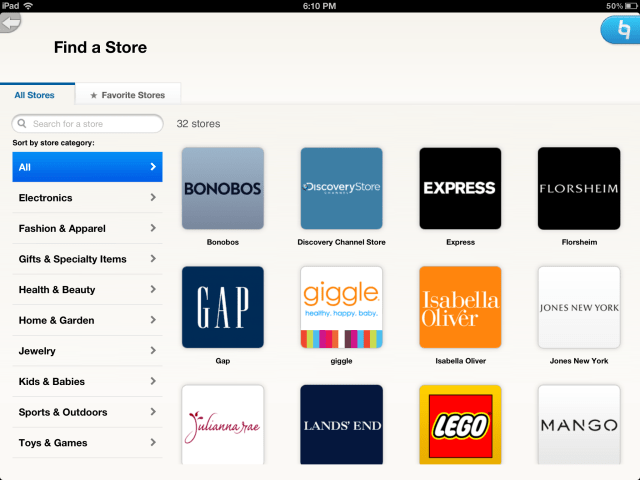
But that’s why Buyou, the crowd favorite here at the TechCrunch Disrupt Startup Alley (and thus one of our Battlefield members), has stepped onto the stage with its iPad app.

It’s a free online mall that aggregates various brands into one beautiful, easy to use interface. And while it’s great that the app begins learning your taste through your likes and dislikes, it’s even better that it relays that information back to its brand partners. This means that a retailer like Express will begin to learn the clothes you like and more easily target clothing you may enjoy directly to you.

Buyou offers up a Featured section, to highlight special products and promotions, as well as a Deal Feed, that throws together all the hottest deals within its retailer network so you can save a buck or two while iPad shopping. You can also shop by category, and save items to a wishlist.

Another pain point that Buyou addresses for retailers is their social presence. Retailers often produce a ton of content for Facebook and Twitter, and even though you may follow them, you’ve likely done so to unlock a deal or be a part of a promotion, not to surf through their content on a daily basis. Buyou filters all its retailers’ social media content through the app and presents it in an unobtrusive, thoughtful way.

The app is currently live in the App Store with 32 retailers already on the platform, including Express, Bonobos, Gap, Lands’ End, LEGO, Nine West, Oakley, and The Sharper Image. The company is currently working on adding new brands.

WP_SLIDESHOW_IMAGES = {load: 'http://s1.wp.com/wp-content/mu-plugins/slideshow/slideshow-loader.gif?m=1289605033g',prev: 'http://s1.wp.com/wp-content/mu-plugins/slideshow/prev.png?m=1269491733g',next: 'http://s0.wp.com/wp-content/mu-plugins/slideshow/next.png?m=1269491733g',stop: 'http://s0.wp.com/wp-content/mu-plugins/slideshow/stop.png?m=1269491733g',play: 'http://s2.wp.com/wp-content/mu-plugins/slideshow/play.png?m=1269491733g'};WP_SLIDESHOW_LABELS = {next: 'Next',prev: 'Previous',stop: 'Toggle Playback'};WP_SLIDESHOW_BLOG_INFO = {blogId: '24588526',subDomain: 'tctechcrunch2011',userId: '0'};This slideshow requires JavaScript.


View the original article here

Airtime Acquires Former Hulu CTO’s Startup Erly, Raises $25M Series B Funding

Colleen Taylor is based in San Francisco where she is a reporter for TechCrunch TV. Previously she worked for GigaOM, where she reported on startups and Silicon Valley. Earlier, Colleen reported for Mergermarket, an online newswire and subsidiary of the Financial Times focused on M&A. Before that, she was a contributing editor for Electronic News, the semiconductor industry trade newsletter. Colleen... ? Learn More

Screen Shot 2012-05-22 at 9.19.00 PM

We’ve discovered that Airtime, the video startup founded by famed Napster alums Shawn Fanning and Sean Parker, has allegedly made its first acquisition — before truly exiting stealth mode. The target? Erly, the Kleiner Perkins-backed startup aimed at letting people create social experiences around their experiences.

Update: We’ve confirmed the acquisition with a source at Airtime, and have been told that it will be announced along with a new $25 million round of funding led by Kleiner Perkins, including Andreessen Horowitz, Google Ventures. As part of the new round of funding, Kleiner Perkins partner Bing Gordon will be joining Airtime’s board of directors as part of the new funding.

Update 2
: The news has now been added to Airtime’s company blog, but at press time their entry does not include details on the size of the funding round.

It seems like an interesting fit at first, but as soon as you scratch the surface it all comes together. Erly’s founder and CEO is Eric Feng, a super sharp young industry vet who previously served as the Chief Technical Officer at Hulu. He alone clearly brings a lot of video and managerial experience to the table. What he’s built at Erly is still very early stage (ha, ha) but from what we’ve seen it’s a solid product. LinkedIn says that the company has around 10 employees.

Airtime, which is set to launch on June 5th, has taken its time to work on building something big. It would make sense that they’d want to bring together a rockstar team to make the most out of that crucial post-launch period. Of course Fanning, and especially Parker, have attained rock star status of sorts in this industry and beyond — which comes with a very unique set of expectations. Bringing on the likes of Feng and his team is a savvy move, for sure.


The new stealth project by Shawn Fanning and Sean Parker. It is believed to be in the video chatting space. Originally codenamed Supyo, it will launch as Airtime.

Learn more

Erly is a new social platform for organizing and sharing your personal content.

Learn more

View the original article here

Friday, May 11, 2012

That Which We Call An Ultrabook By Any Other Name Would Smell As Sleek

Biggs is the East Cost Editor of TechCrunch. Biggs has written for the New York Times, InSync, USA Weekend, Popular Mechanics, Popular Science, Money and a number of other outlets on technology and wristwatches. He is the former editor-in-chief of Gizmodo.com and lives in Bay Ridge, Brooklyn. You can Tweet him here and G+ him here. Email him directly at... ? Learn More

Screen Shot 2012-05-10 at 8.58.35 AM

Yesterday, to much fanfare and resolute sentiment, HP announced a return to what made it a great company to begin with: poorly-named and generic computing devices tarted up to take on Dell. This year it’s the HP Envy SpectreXT, a thin and light that can’t officially be called an Ultrabook because that’s an Intel marketing term and these things sometimes run on AMD chips.

I think it’s important to point out the clear problems in the above statement: because Intel officially controls the “ultrabook” spec – including the pricing, screen size, speed, and physical size – manufacturers must toe the line when it comes to what can and cannot be sold under that rubric. In short, Intel’s own standards have so long stymied the OEM’s ability to innovate that, in the end, we’re all essentially buying Intel PCs no matter the brand or maker.

Why is this an important distinction? Because for years hardware has been stymied by ridiculous size standards. From the early “Windows” tablets – which had to follow Intel’s exacting guidelines – to today’s Ultrabooks, manufacturers can’t make a penny without kowtowing to Intel. What’s more, they don’t get any of Intel’s marketing might if they don’t produce at least one of a family of devices.

The same thing happens over at Microsoft. Remember when, in 2010, it seemed everyone was making one touchscreen PC? Sony? Dell? HP? Well it wasn’t because they were totally into touchscreen. It was because Microsoft wanted to push touchscreen Windows interaction onto the audience and they could use their might to force at least one SKU from each manufacturer.

Could HP fight back? Probably not. They make all their money on ink anyway, and hardware is a loss leader. In short, the PC industry is a perfect example of trickle-down economics.

There are obviously a number of smaller players who don’t toe the line, including Apple, but in general if you want to appear in the Best Buy circulars and get special bulk deals on chips and operating systems, you’d better be willing to go Ultrabook or Centrino or whatever other standard the binary star of Intel and Microsoft encourages makers to follow. The odds – and profit – are forever in Intel’s favor.


View the original article here

‘Anonymous’ Social Network Anybeat Is Getting Bought And Shut Down. Dmitry Shapiro Going To Google+?

Ingrid is a reporter for TechCrunch, joining February 2012, based out of London. She comes from paidContent.org, where she was a staff writer, and has in the past also written freelance regularly for other publications such as the Financial Times. Ingrid covers mobile, digital media, advertising and the spaces where these intersect. When it comes to work, she feels most... ? Learn More

anybeat1

Anybeat, a social network that launched last year as a kind of “anti-Facebook” to meet people you don’t already know, is getting bought by another company and is shutting down. The company posted a message to its users a few hours ago noting that it would be closing up operations in two weeks.

The service, which launched as a beta in September 2011 (we offered invites here), was founded by Dmitry Shapiro, who had also founded Veoh and at one point had been the CTO of MySpace. It’s been reported that he is moving to Google to head up Google +.

Anybeat has posted news of the shutdown on its own page in Anybeat.

In the note, Anybeat says that it is getting purchased by another company — it doesn’t say who — and that new owner will be “repurposing it to address a different type of community, and will not be operating Anybeat as is.” It has also offered a link to a Google Group that will let users stay in touch.

It’s not clear how many users Anybeat picked up in its short life, but if you consider that Facebook now has 901 million active subscribers, that’s a pretty high bar to hit for any social network to consider itself as having reached a critical mass.

Anybeat’s unique selling point was its option of anonymity — once something that seemed part and parcel of online personalities, but more recently — not least because of Facebook — replaced by full-on real name usage as the norm for many people. It’s unclear whether any of what Anybeat was doing will be carried over into whatever comes next.

Shapiro has another project on the boil – Uberpaper – a social news-aggregating service that had a similar layout to Anybeat with blocks of text in a scrolled layout (they were created by the same developers, it seems). For now that service appears to still be going.

We are contacting Google and Dmitry to ask about the reports of his career move to Google +, and to ask for more details about who has bought the company — although as of yesterday Shapiro was noting that this information has yet to be disclosed.

If reports of Shapiro’s move are true, could it be Google itself? Is that why the company is suggesting a Google Group to carry on relationships post-Anybeat? It would seem very ironic given that the note below says “I don’t do Google.” In the meantime, here is the note that Anybeat has posted to users:


Dmitry Shapiro is a serial Internet entrepreneur. He is currently the Founder and CEO of Anybeat (formerly known as Altly) a social networking startup. Prior to Altly, Dmitry was the CTO of MySpace Music. Prior to that Dmitry was the founder and CEO of Veoh Networks, one of the larger online video services (sold to Qlipso), founder and CEO of Akonix Systems, a P2P security company (sold to Quest Software), and Chairman of iList/Irata (sold to IGN). Prior to his entrepreneurial...

Learn more

View the original article here

 
Design by Wordpress Theme | Bloggerized by Free Blogger Templates | coupon codes